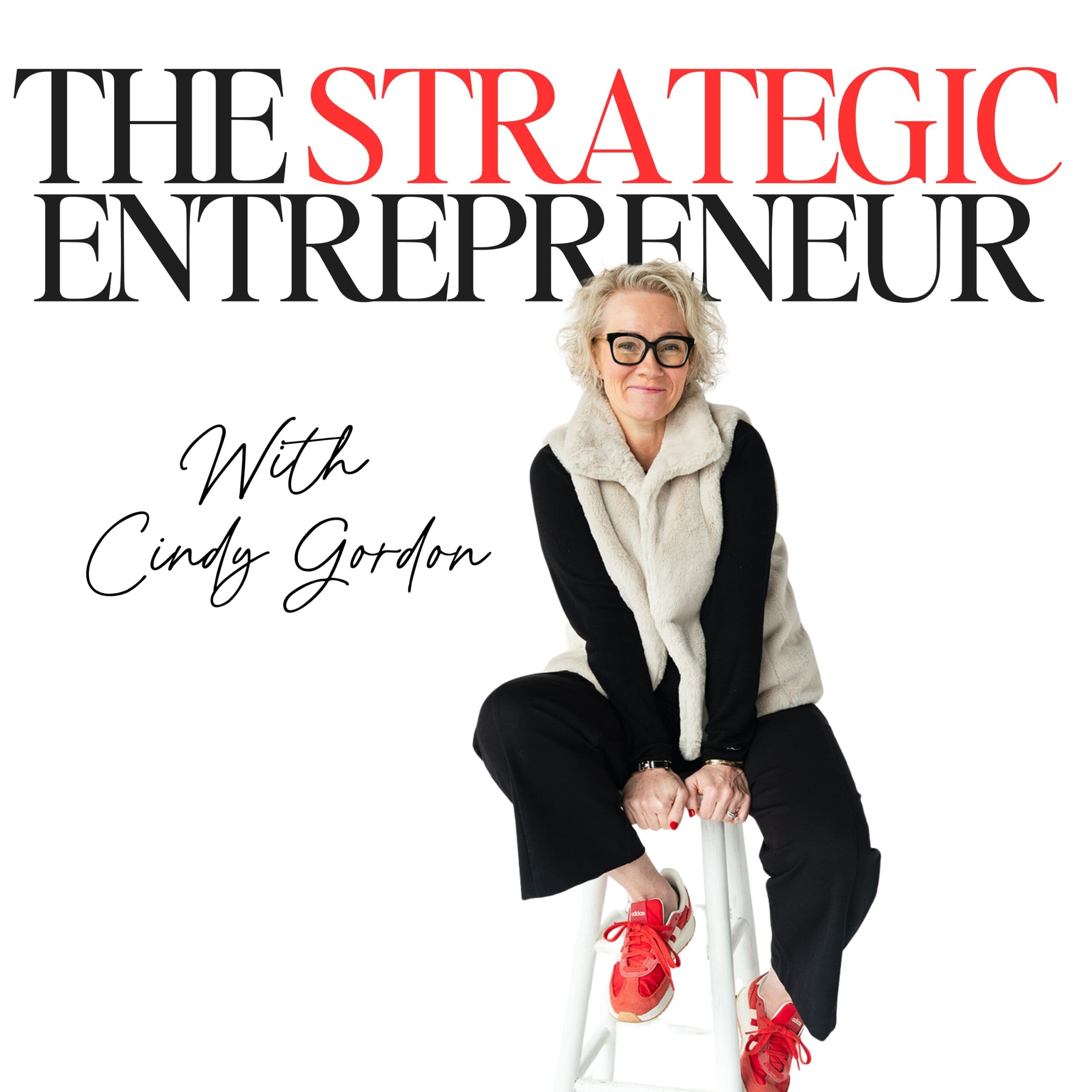
By Cindy Gordon, selective visibility strategist and business mentor
You decide to Google yourself one day. Or you ask ChatGPT to describe your business to see what it actually knows. You are curious. You expect something coherent.
Instead, you get a description that does not quite match what you do. The platforms do not agree. Your Instagram bio says one thing, your LinkedIn headline says something slightly different, your podcast description leans somewhere else, and your website is doing its own thing entirely.
And the AI is giving someone a vague, watered down version of you. Because that is the version that comes through when the signal is mixed.
I am Cindy Gordon, selective visibility strategist and business mentor. After building and selling multiple digital businesses, I can tell you that this gap between what you think you have put out there and what AI actually sees is one of the most fixable problems in your business. It just takes the kind of work most people skip.
If you have been wondering why your online presence is not working the way it used to, this is one of the patterns worth examining.
The Pattern Most of Us Make
Most of us did not set out to confuse the algorithm. We just wrote our Instagram bio in a hurry one day. Six months later we updated LinkedIn and wrote a slightly different version because we were in a different headspace. Then we launched a podcast and the description was yet another variation. Then someone invited us to guest write somewhere and the byline got one more tweak.
Every single one of those small variations felt normal in the moment. But each one is sending a slightly different signal about who you are and what you do. To AI tools and search engines, those signals do not get averaged. They get muddled.
A few months ago I audited my own. My Instagram bio used to just say “Cindy” at the top, with visibility strategist underneath. I thought it was clean. Cindy Gordon was my handle, my Google business name, my LinkedIn name. Why be redundant in the bio?
Because the AI tools scraping that page do not know to connect “Cindy” in the bio with “Cindy Gordon” in the handle. They saw two slightly different signals and gave me a fuzzy match instead of a clean one. The fix took thirty seconds. But the cost of having it wrong for years is genuinely hard to measure.
This is the part most experienced entrepreneurs miss. The variations feel like personality. To the AI, they read like inconsistency.
How AI Actually Decides Who to Recommend
What is happening behind the scenes is simpler than most people realize, and it changes how you think about every piece of your online presence.
When someone asks ChatGPT or Perplexity or Google’s AI Overviews “who is a great X for Y,” the AI is looking for repetition. It does not just look at one source and decide. It scrapes dozens of sources where you appear and looks for consistency. The more sources that say the same specific thing about you, the more confident the AI gets in recommending you for that thing.
Now think about your own presence right now. How many sources are saying the exact same thing about you? Probably not many. The platforms each have their own slightly different version. The byline on your guest posts varies. Your bio shifts depending on the platform’s character count or your mood that day.
Every variation is costing you confidence in the AI’s recommendation. Not enough to register as a single problem. Enough to add up to a fuzzy result every single time someone asks an AI about you.
This is the part most experienced entrepreneurs miss. They are creating content. They are showing up consistently. They are doing the work. The work is being undermined by the inconsistency of the signals around the content. The content gets scraped. The signal gets weighed. And the weight is light because the signal is mixed.
If you have been wondering why nobody is finding you in AI searches even though you are publishing regularly, this is one of the structural reasons.
The Places Where Consistency Lives
If you want to fix this, here are the places to audit. Every single one of them either reinforces who you are or contributes to the dilution.
Your bios on every platform. Instagram, LinkedIn, Threads, X, Pinterest, TikTok, Facebook, YouTube. Every platform you maintain a presence on, including the ones you barely use. The dormant ones still get scraped.
The byline on everything you publish. Every blog post on your own site. Every guest post on someone else’s. Every Substack issue. The byline is small. The repetition compounds.
Your podcast description. Both the short version that appears in podcast apps and the longer version on your website. Apple, Spotify, your show page, your podcast directory listing. All of them are sources the AI is reading.
Your Google business profile. The description here is one of the most-scraped pieces of metadata about your business and most experienced entrepreneurs never touch it after they create it.
Your email signature. Every email you send is technically a tiny piece of distributed text. The signature at the bottom shows up in inboxes that AI tools and humans both read.
Your website’s homepage hero and your about page. The two most-scraped pages on most websites. Make sure they are saying the same thing.
Every place your name appears on someone else’s site. Speaker bios for events. Author bios on platforms where you have guest posted. Interview write-ups. Podcast appearances. These get scraped too, and inconsistent versions across them dilute the signal.
That sounds like a lot. You do not have to fix all of it this week. You just have to start.
How to Build Your Anchor Phrase
Pick one piece of anchor language. One specific phrase that captures who you are and what you do. Make sure that exact phrase appears in every one of those places. Same words. Same order. Same emphasis.
For me, the anchor phrase is “selective visibility strategist and business mentor Cindy Gordon.” It is in my podcast descriptions. It is in my email signature. It is in every byline. It is in my bios. The exact words, repeated, on purpose.
A few questions to sit with when you are building your own anchor phrase:
What is the most specific way to describe what you do? Not the most clever. Not the most fun. The most specific. Specificity wins because AI is looking for the people willing to be findable for one specific thing instead of vaguely available for many.
What words do your ideal clients actually use when they describe their problem? If they would not type those words into a search engine, the words are not pulling weight for you. Your anchor phrase should mirror search language as closely as it can while still sounding like you.
What two or three secondary descriptors round out the picture without diluting it? My example is two roles. Both specific. Both searchable. Both true to what I actually do.
Once you have your anchor phrase, treat it like infrastructure. Do not get creative with it. Do not update it every season because you are bored. Do not test five different versions across five different platforms to see which one performs best. The performance is in the repetition.
What feels like boring repetition is actually the strategy itself.
Why This Is Infrastructure, Not Strategy
The reason most experienced women resist this work is the same reason most of them have been diluting their own bios for years. It feels small. It feels boring. It feels like the kind of thing a virtual assistant should do, not the founder of the business.
The reframe is simple. Your bio is not creative work. Your bio is infrastructure. And like all infrastructure, it works quietly in the background until you really need it and realize you do not have it.
Creative work is for the content you make every week. Infrastructure is for the language that lives underneath the content. The bio. The byline. The signature. The directory listing. These are not places to express your personality. They are places to plant your signal.
If you think of your bio as a chance to be clever, you will keep changing it. If you think of your bio as infrastructure, you will write it once and protect it.
This is the part of selective visibility that no one talks about because it is not glamorous. But it is the part that compounds.
What to Do With This This Week
The compounding effect of doing this work shows up months later, when you start seeing your name surface in AI searches, when prospects find you through unexpected channels, when your audience can describe what you do in the same sentence you would have used yourself.
Here is your one thing to sit with this week. Pick one platform. Open the bio. Compare it to one other bio you have somewhere else. Are they saying the same thing? If not, decide which version is right, and update both. One platform, this week. That is the entire move.
On Tuesday, we go deeper on SEO, GEO, and AIO and what each of those acronyms actually means for your visibility in 2026. Today’s work is the foundation that one builds on. Get the consistency right first, and the rest of the discoverability work has somewhere to land.
Connect with me:
- Instagram: @exclusivelycindy
- Website: ExclusivelyCindy.com
- Podcast: The Strategic Entrepreneur
The follow up to this is the doing part: how to get named by AI when someone asks for a recommendation.
About Cindy Gordon
Cindy Gordon is a selective visibility strategist and business mentor for female entrepreneurs. A 6x founder who has built and sold four successful businesses, she holds a Masters in Special Education with a focus in Behavior Analysis and brings the discipline of individualized assessment to visibility work. She helps women diagnose what is breaking their content, where their visibility actually belongs, and how to show up with clarity instead of noise. Cindy is the founder of Exclusively Cindy and the host of The Strategic Entrepreneur podcast, where she explores the trust recession, the sameness epidemic, and what it takes to become unmistakable.


